
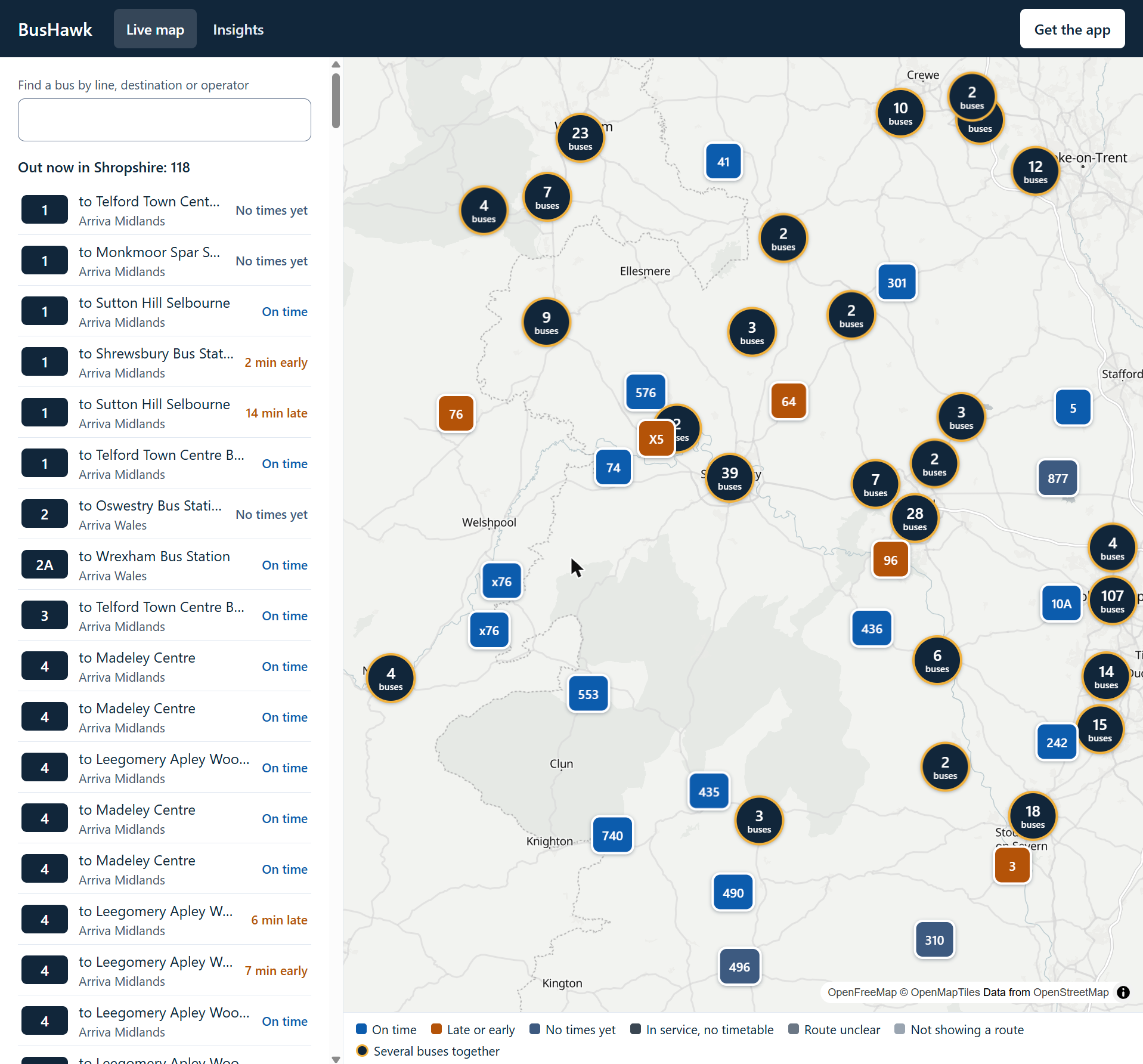
This autumn we set out to answer one question about one rural bus route: where is my bus right now? BusHawk now follows every public bus in and around Shropshire, sends an alert to your phone as yours gets close, and publishes how the county’s buses have been running. It is our own product, built and run by Agile Tea, and you can try it today.
The data is free. Making it reliable is the work
Bus operators in England publish their timetables and the live locations of their buses to the Department for Transport’s Bus Open Data Service. Anyone can use it. BusHawk reads the live positions every ten seconds and matches each bus to the journey it is running, so it can work out when it will reach every stop ahead.
That sounds simple. The real data is not. We recorded every response from the start and replayed it while we built, and every one of these rules came from something we actually saw:
- Old news. Some location reports arrive minutes late. Anything more than two minutes old is ignored.
- Wandering positions. GPS drifts. A position more than 100 metres from the bus’s route is set aside.
- Buses that go backwards. A report that jumps back more than 150 metres along the route is rejected.
- Impossible journeys. Early on, one bus was still reporting its 1:05pm journey at 3:35pm. A bus that could not be running that journey is not believed.
- The odd web page. About one request in 150 comes back as a web page instead of data. It is recorded and skipped, never allowed to crash anything.
One route to start, every route by design
We began with a single route, the one we wanted to catch. But the code is not allowed to know which route that was. An automated test fails the build if any part of the product names a particular route, operator or stop. The first route was a test case, not something to tune for, which is why going from one route to the whole county did not mean starting again.
Private by design
We decided what BusHawk would never know before we wrote it, and the code is checked against those promises:
- No account. We never ask for a name, email address or phone number.
- Your location never leaves your phone. Nearby stops are worked out on the phone itself.
- The stops you watch are deleted two hours after your bus has passed.
It works in the phone’s web browser and can be added to the Home Screen like an app, with alerts, so there is nothing to download from an app store. Android users can also join the public test of the BusHawk app from bushawk.uk.
How Shropshire’s buses have been running
Because BusHawk follows every bus, it can also show how well the county’s buses keep to time. Between 12 and 22 November 2026, 19,167 journeys were due. Of the journeys we saw, 69% were on time.
We were careful about what those figures can and cannot say. On time uses the Traffic Commissioners’ measure for local buses, from one minute early to five minutes 59 seconds late. A bus that sent no location is shown as not tracked and is never counted as late, because it may well have run. The figures are worked out every night, by operator and by line, at insights.bushawk.uk.
What it says about how we work
BusHawk has been built up over the autumn, from the first conversations about the problem to a pilot with real users, in the same way we build for customers: small working pieces, automated tests from the start, and rules the build enforces rather than ones we hope to remember. It runs on Microsoft Azure, and the security approach in why we patch software nobody asked us to change applies to it too.
If you catch buses in Shropshire, give BusHawk a try; it is free while we test it. You can read more in the BusHawk case study.